Ready-Made Billing Software vs Custom: What Your Business Actually Needs (India, 2026)
An honest India-specific guide to choosing between ready-made billing apps like Vyapar and myBillBook and getting software built for your business — with real costs and a real example.
There is a specific moment that sends Indian business owners looking for software. The notebook is full, a payment has been missed, or a customer has asked for a proper GST invoice and the reply took two days.
The advice that follows is almost always the same: get Vyapar. Or myBillBook, or Khatabook, or Marg. And most of the time that advice is correct — we say it ourselves, for free, to people who call us wanting to commission software.
But sometimes it’s wrong, and the businesses it’s wrong for tend to discover it slowly: they buy the subscription, use it for two months, and quietly go back to the register because the app cannot do the one thing their business runs on.
We build custom web apps for Indian small businesses, so we have an obvious interest here. That’s exactly why this guide spends most of its length telling you when not to hire us.
Start by admitting what ready-made apps are good at
Ready-made billing apps are one of the best deals in Indian small business software. Vyapar’s entry plan is around ₹1,999/year; myBillBook starts near ₹33/month for basic Android billing and around ₹2,599/year for web and iOS access. For that you get GST invoices, e-way bills, stock, payment reminders and reports, maintained by a company with hundreds of engineers, updated whenever GST rules change.
You cannot buy that with ₹60,000 of custom development. You aren’t even close. Anyone who tells you otherwise is selling.
So the honest default is: use a ready-made app. If you sell products that have a price — a kirana store, a hardware shop, a distributor, a pharmacy, a garment retailer — download one, use it properly for a month, and stop reading here. You will have solved your problem for the cost of a decent phone case.
The question this guide answers is narrower: what do you do when you’ve tried that and it doesn’t fit?
The one question that decides it: is your price looked up, or calculated?
Almost every ready-made billing app in India is built on one assumption — that your business has a list of items, and each item has a price. Invoicing is then a matter of picking items and quantities.
That assumption holds for most businesses. When it doesn’t, nothing else in the app quite works either.
Ask yourself how you answer a customer who asks “what will this cost?”. If the answer is look it up, you are the ready-made case. If the answer is let me calculate, you may not be:
- A label and tag manufacturer prices by paper GSM, size in inches, rate per square inch and quantity.
- A fabrication shop prices by weight of material, plus labour, plus finishing.
- A printing press prices by sheet size, colours, paper and run length.
- An interior contractor prices by area, material grade and site.
- A transporter prices by route, weight and vehicle type.
In every one of those, the ready-made app has no place to put the calculation. So the calculation stays on paper, and the app becomes a typewriter — you work out the figure by hand, then type the final number in. That’s not software doing your billing. That’s you doing your billing, twice.
A real example: pricing a hang tag
We recently built an internal system for Shiv Shakti Label, a garment label and hang-tag manufacturer in Surat. It’s a useful example because it’s not exotic — thousands of Indian job-work businesses price exactly this way.
A hang tag’s price comes from four things at once: the GSM of the paper it’s printed on, its width and height in inches, a rate per square inch, and how many are needed. Then, often, a dori — the thread that attaches the tag to the garment — is added on top, priced separately by type.
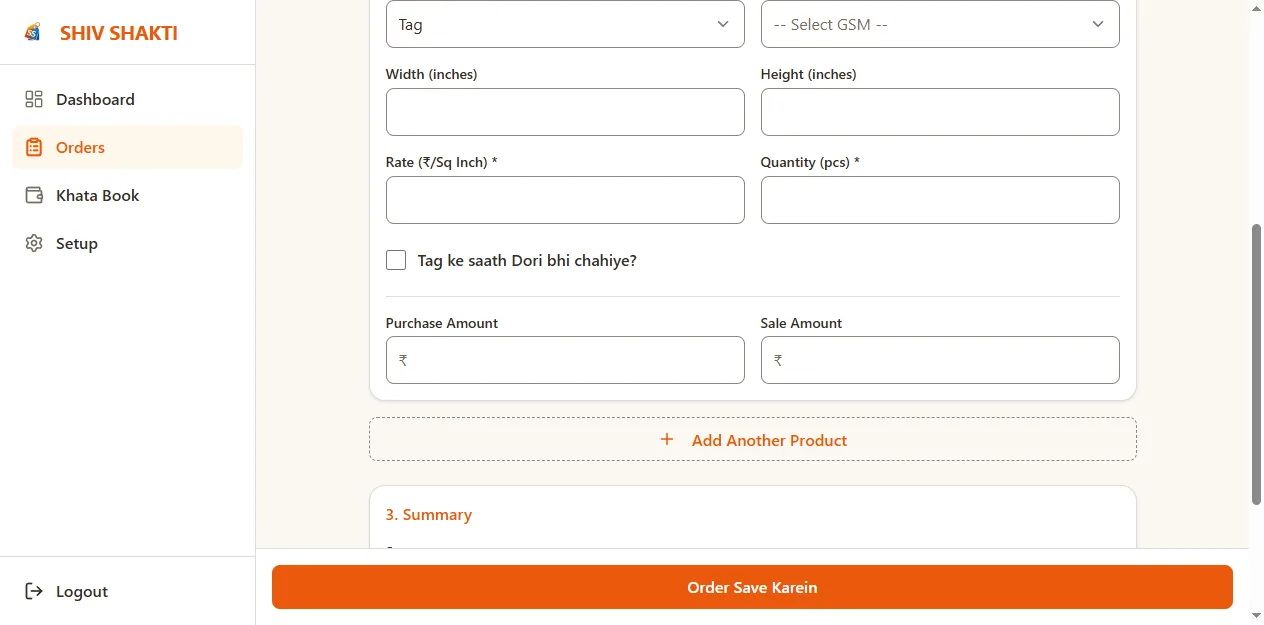
So the order screen had to be the calculation, not a form to record its result:
You pick the party, the supplier the material came from, and optionally the sales agent who brought the order. Then per product: type, GSM, width, height, rate per square inch, quantity, and a tick-box for dori. Purchase amount, sale amount and estimated profit resolve as you type.
That last part matters more than it sounds. Because cost is captured next to the sale, every order carries its own margin:
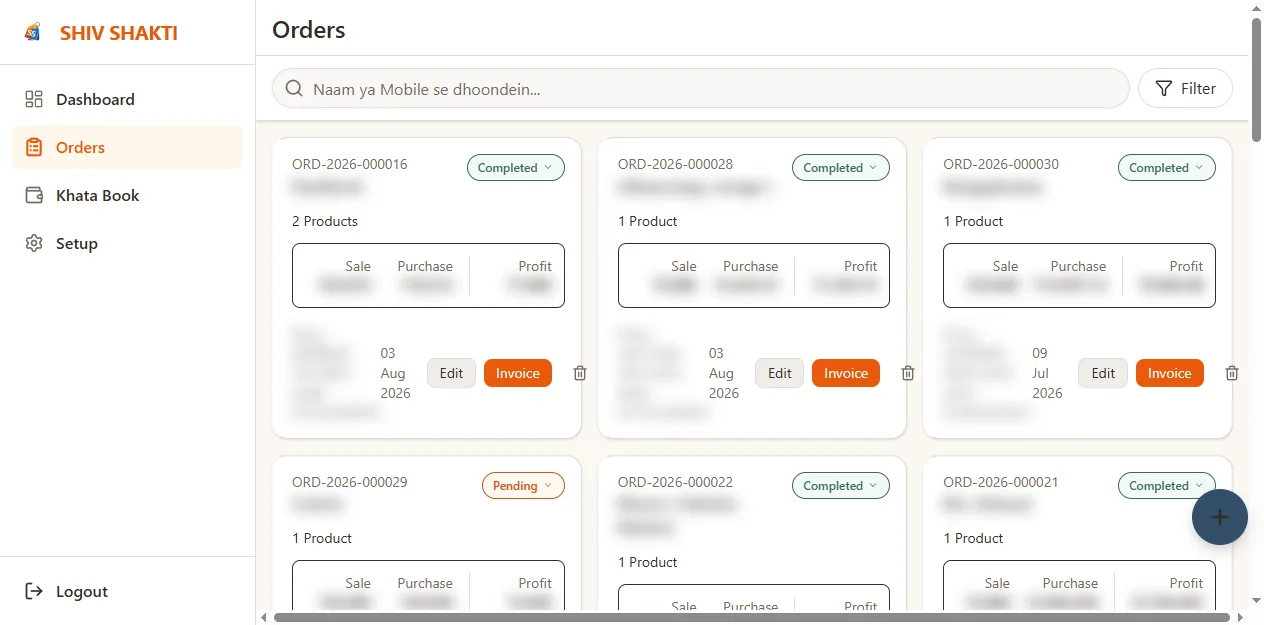
(Customer names and figures are blurred throughout — it’s a live business.)
No ready-made billing app was going to do this. Not because those apps are bad, but because “rate per square inch, and does it need dori” is not a feature anyone builds for a general market. It’s the specific shape of one trade.
The second signal: work that has nowhere to live
The pricing test catches most cases. The other common one is subtler — parts of your business that the app has no concept of, so they end up in a parallel register.
In the Shiv Shakti build, three things had that problem: money owed by customers, money owed to raw-material suppliers, and commission owed to sales agents. Three different relationships, each with its own running balance, previously in three separate books that only reconciled when someone sat down and added them up.
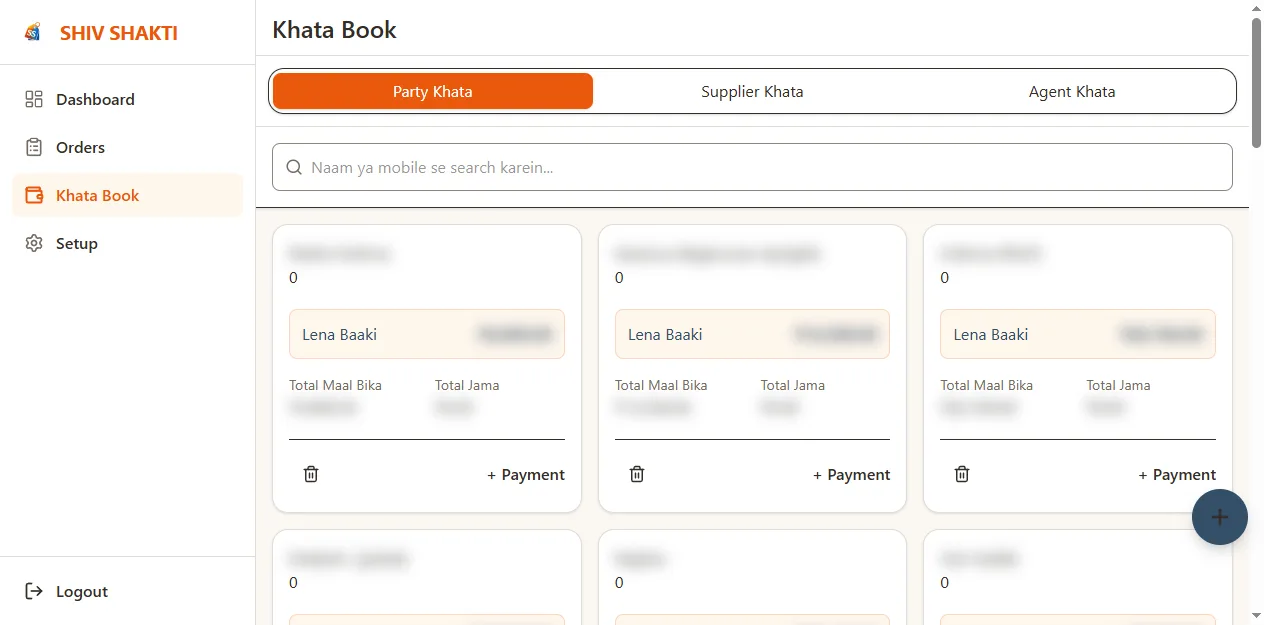
Generic apps give you customers and maybe suppliers. Sales agents with commission rates, job-work in and out, raw material consumed per order — these are normal in Indian manufacturing and almost never present in a billing app.
The test is simple: what do you still write down outside the software? If the answer is “nothing”, the software fits. If you keep a separate diary for agent commission or material issued, that diary is telling you where the app ends and your business begins.
The third signal: entering the same thing twice
The last signal is pure waste. You take an order on WhatsApp, write it in a register, type it into a billing app to make the invoice, and enter it again in a sheet to track payment. The same facts, four times.
Every re-entry is a chance to get a number wrong, and the wrong number in billing costs real money. When a system captures the order once and the invoice comes out of it — same figures, no re-typing — that whole class of mistake disappears.
If you want to fix only this part and keep the app you already have, that’s often possible without a full custom build: automating GST invoice generation with a form and a workflow is a much smaller project. That guide covers the cheaper middle path in detail.
What custom actually costs, honestly
Here are our real numbers. A web app of this kind starts at ₹60,000 and takes three to five weeks. Optional ongoing maintenance starts from ₹5,000/month, tailored to the system. Fixed quote up front, no hourly billing.
Compare that properly:
| Ready-made app | Custom build | |
|---|---|---|
| Up front | ₹0 | from ₹60,000 |
| Per year | ~₹2,000–3,000 | ₹0 licence (maintenance optional) |
| 5-year cost | ~₹13,000 | ~₹60,000+ |
| Fits your process | Only if standard | Built to it |
| Works on day one | Yes | 3–5 weeks |
| Updated for GST changes | Automatically | You arrange it |
| You own it | No | Yes |
Custom is not cheaper. Anyone framing it as a saving is misleading you. Over five years a ready-made app is roughly a fifth of the price, and it comes with a company maintaining it.
Custom wins on different grounds: it removes work that costs you hours every day, it stops you quoting wrong, and it gives you something you own outright with no per-user fee as you grow. If you can’t point to one of those, the honest answer is a subscription.
Our rough rule: if you can’t identify at least an hour a day of work it removes, or a real margin leak it closes, don’t build it yet.
What to do before you commission anything
Whatever you decide, do these four things first. They cost nothing and they change the outcome.
- Actually use a ready-made app for a month. Not an afternoon. Most people who tell us “it doesn’t fit” have never entered a full week of real orders into one. Some discover it fits fine.
- Write down what you do outside it. Every workaround, every side register, every calculation on paper. This list is your specification, and it’s worth more than any feature wishlist.
- Write down your rates. GSM rates, per-unit rates, commission percentages, discount rules. If pricing lives only in one person’s head, that’s the real project — and it’s the part that slows every build down.
- Get a fixed quote and confirm ownership. Code, database and hosting in your name, logins handed over. Fixed price, not hourly. If either is refused, walk.
The honest summary
Most Indian small businesses should use Vyapar or myBillBook and never think about this again. That is not a compromise; it’s the right answer, and it’s the advice we give people who ring us hoping to spend money.
Custom software earns its cost in a narrower case: when your price is calculated rather than looked up, when real parts of your business have nowhere to live in a generic app, or when you’re entering the same data repeatedly because two systems don’t talk. Shiv Shakti Label hit all three. Most businesses hit none.
If you’re genuinely unsure which side you’re on, that’s a twenty-minute conversation, not a project. Book a free call and we’ll tell you honestly if a ₹2,599 subscription solves it — we’d rather say that than build you something you didn’t need.
Quick questions
Is Vyapar or myBillBook enough for a small business in India?
For most small businesses, yes — and you should try one before spending anything on custom software. If you sell items that have a price, ready-made billing apps handle GST invoices, stock and payment tracking for roughly ₹2,000–3,000 a year. Custom only makes sense when your pricing or your process doesn't fit that shape.
When is custom billing software actually worth it?
Three signals, and you usually need at least two: your price is calculated rather than looked up (per square inch, per kg, per hour, per design); you're re-entering the same data into two or more places every day; or a real part of your business — job work, agent commission, raw-material costing — has no place to live in the app you're using.
How much does custom billing software cost in India?
At Widox, a web app of this kind starts around ₹60,000 and takes three to five weeks. That's the honest floor for something built around your process, owned by you, with no per-user fee. Below roughly ₹40,000 you are almost always better served by a ₹2,599/year subscription.
What's the real cost difference over five years?
A ready-made app at ~₹2,600/year is about ₹13,000 over five years. Custom starts near ₹60,000 plus optional maintenance from ₹5,000/month. Custom is not cheaper on paper — it wins when it removes hours of daily work or stops you from quoting wrong, not because of the licence fee.
Can custom software generate proper GST invoices?
Yes. A GST tax invoice is a defined format — GSTIN, PAN, place of supply, tax per line, invoice number and date. Any competent build produces that correctly, with your business details already filled in. Ask to see a generated invoice before you pay for the whole system.
Will I be locked in to the developer who builds it?
You shouldn't be. Insist on owning the code, the database and the hosting account in your name, with logins handed over on delivery. If a developer keeps the code or hosts it on their own account without giving you access, you're renting your own system — and you'll discover it the day you want to change something.
Can I start with a ready-made app and move to custom later?
That's the sensible path, and it's what we usually recommend. Run the ready-made app until it visibly breaks against your process, and keep a note of what you have to do outside it. That note becomes the specification — and it's far better than guessing what you need on day one.
What about Tally — isn't that the standard?
Tally is accounting software, and it's very good at accounts. It is not built to price a job, run a shop floor, or replace the register your staff actually write in. Many businesses correctly run both: an operational system for the daily work, and Tally or a CA for the books.
How long does custom billing software take to build?
Three to five weeks for a first working version, assuming you can describe your process and your rates clearly. The rates and master data are usually the slow part, not the code — if your pricing lives only in someone's head, expect to spend time getting it written down.
Does the software need to be in English?
No, and often it shouldn't be. If the people entering orders think in Hindi or Gujarati, labelling a screen 'Lena Baaki' instead of 'Accounts Receivable' is not a cosmetic choice — it's the difference between a system that gets used and one that gets abandoned after a fortnight.