What a Coaching Institute Website Should Actually Do (India, 2026)
A practical guide for coaching class owners in India — what your website must do to bring admissions, what it should cost in 2026, and what to skip. With a real example.
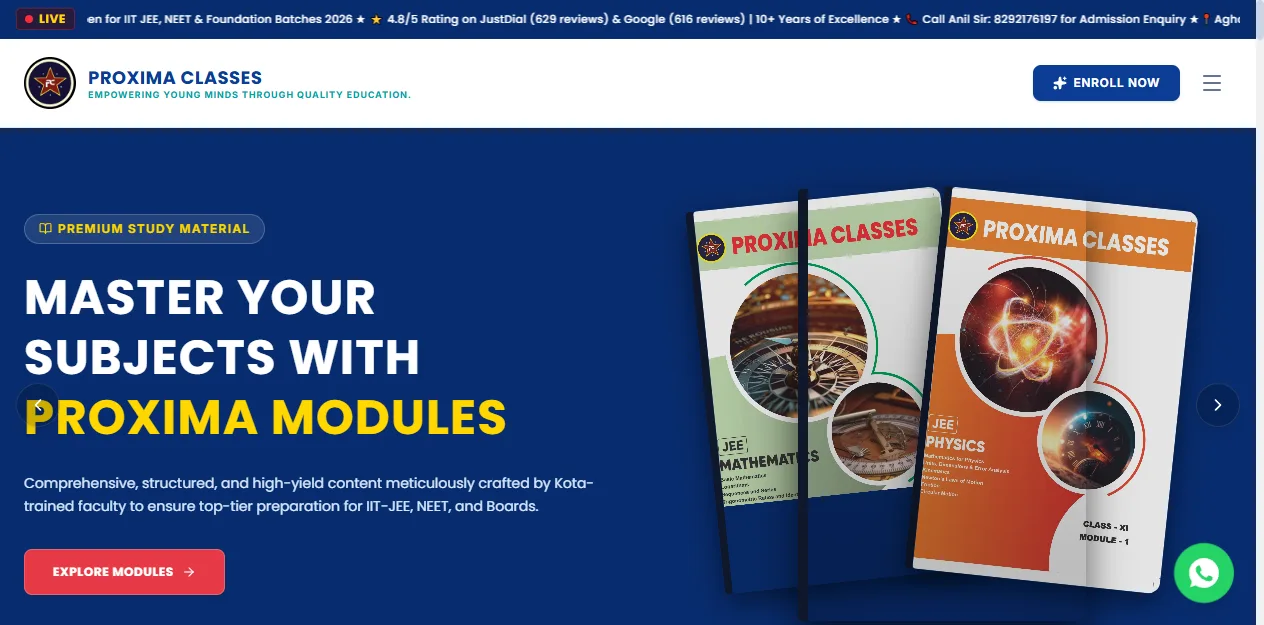
Drive through any Indian town in May and you’ll see it: coaching institute banners on every pole — toppers’ faces, ranks, percentages. Real proof, real effort, real money spent.
Then a parent does what parents do now. They hear the institute’s name, and before calling, they search it on Google.
And too often, what comes up is nothing. Or a website last touched in 2023, with courses that no longer run and a contact form that goes nowhere. The banners did their job; the website threw the admission away.
We run a web studio and coaching institutes are the businesses we work with most — including a portal that runs a 900+ student institute. This guide is what we tell owners when they ask what a website should actually do. No jargon, real numbers, and a clear line between what fills seats and what wastes money.
Parents check your website before they call
The admission journey has quietly changed. It used to be banner → visit → admission. Now there’s a step in the middle: banner → Google search → visit (or not).
That middle step is where a website earns its fee. A parent searching your institute’s name is about as warm as a lead gets — they already know you, they’re already interested. Your website’s only job is to not lose them. It loses them when:
- The site takes ten seconds to load on a phone (most parents are searching on one).
- There’s no proof — no results, no faculty, no photos of actual classrooms.
- There’s no obvious next step — no number to tap, no WhatsApp, no form.
It keeps them when the opposite happens: the site opens fast, shows real results and real teachers, answers the fee question at least roughly, and lets them ask a question in one tap. None of this is fancy. All of it is decisive.
If you’re still weighing whether you need a website at all when you already have an Instagram page, we wrote an honest comparison: website vs Instagram for a small business. Short version: Instagram builds awareness, the website closes.
The six jobs of a coaching institute website
Strip away the design talk and a coaching website has six jobs. If yours does these, it’s working. If it doesn’t, no amount of animation will save it.
1. Catch admission enquiries — instantly. A short form (name, phone number, class) and a WhatsApp button. Every enquiry should land in your inbox and on your phone the moment it’s submitted. Speed matters more than polish here: an enquiry answered in five minutes and one answered the next morning are two different admission rates.
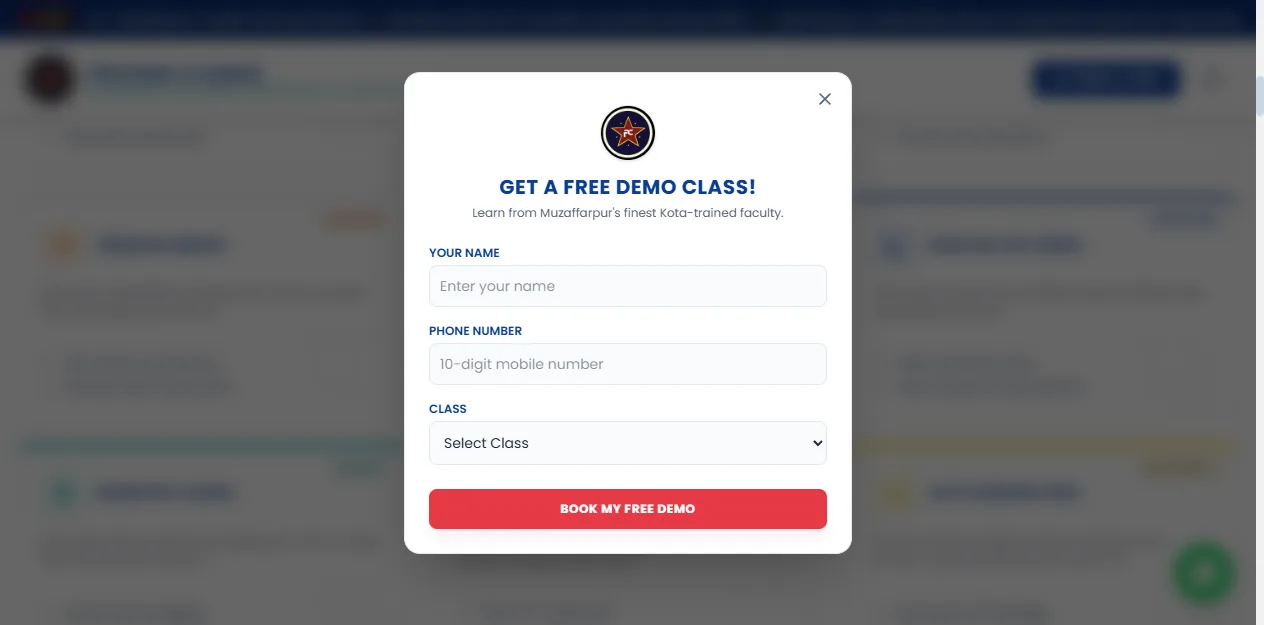 A demo-class form we built for Proxima Classes — three fields, nothing more. Every extra field costs you enquiries.
2. Prove your results. This is the emotional core of the site. Real students, real ranks, real photos, with permission. Parents in your town know who actually cleared what — honesty here is not just ethics, it’s strategy.
3. Show courses and batch timings clearly. Which classes, which streams (JEE / NEET / boards / foundation), which timings, online or offline. A parent should find their child’s exact situation in under a minute.
4. Put faces to the teaching. Faculty profiles with genuine credentials. “Kota-experienced faculty” means something to parents — but only with names and faces attached. Anonymous excellence convinces nobody.
5. Answer the fee question — at least roughly. You don’t need to publish a full rate card. But “batches from ₹X/month” with a talk to us button beats total silence. Parents comparing three institutes quietly drop the one that hides everything.
6. Show what makes you different. AC classrooms, small batches, a library, double-faculty system, test series — whatever is genuinely true for you, show it with photos rather than adjectives.
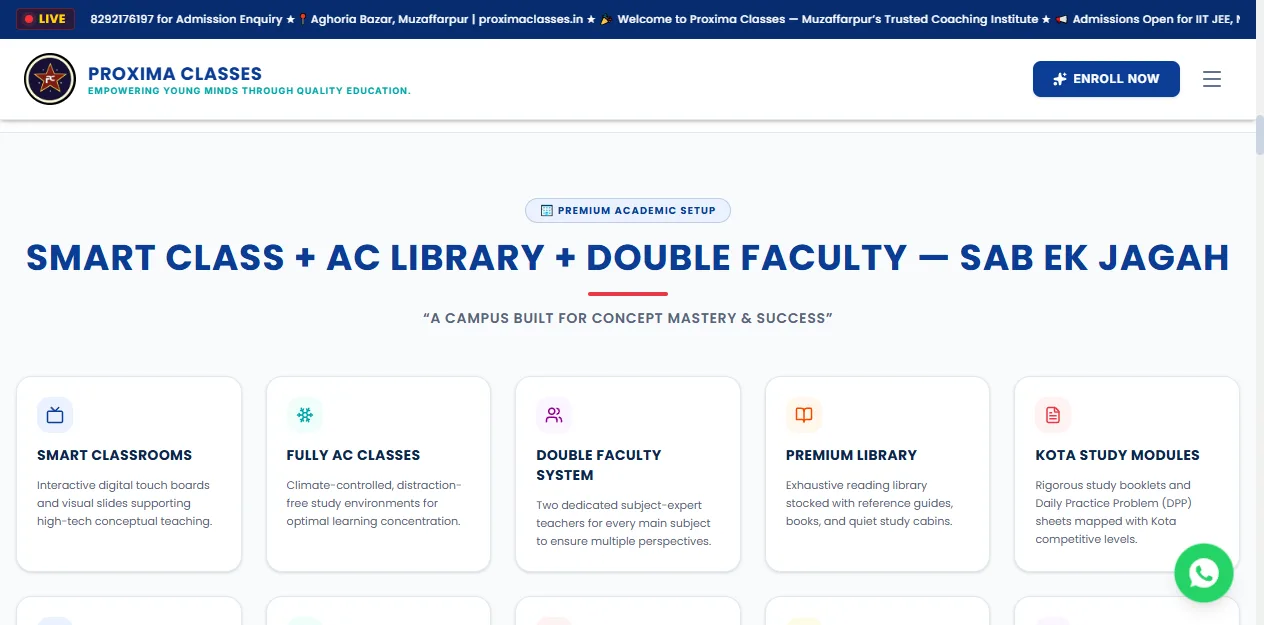 Show, don’t claim: facilities laid out as specifics, not slogans.
That’s the whole job description. Notice what’s not on the list: a blog nobody will write, a gallery of 400 unsorted photos, an app. Those come later, if ever.
Features that fill seats vs features that waste money
Coaching owners get sold a lot of things. Here’s our honest sorting, from building these sites:
| Worth paying for | Usually a waste (at the start) |
|---|---|
| WhatsApp + call buttons on every page | A mobile app for the institute |
| Enquiry form that alerts you instantly | Login systems “for later” |
| Results wall with real students | Stock photos of foreign classrooms |
| Course & batch pages parents can skim | 20+ pages of filler text |
| Fast loading on cheap Android phones | Heavy sliders and animations |
| Google Business Profile + basic local SEO | A vague “SEO package” with no specifics |
| Photos of your actual campus | Auto-playing background music (yes, still) |
The left column is cheap. The right column is where budgets die. If a proposal is heavy on the right and light on the left, you’re being sold decoration, not admissions.
What a coaching institute website costs in India in 2026
Real numbers, because “it depends” helps nobody. We’ve written a full breakdown of what websites cost in India, but for coaching specifically:
| What you’re buying | Realistic 2026 range | When it makes sense |
|---|---|---|
| Admissions website (5–6 pages, enquiry + WhatsApp) | ₹15,000 – ₹40,000 | Every institute, from day one |
| Admissions site + online fee payment | ₹25,000 – ₹60,000 | If parents keep asking to pay online |
| Student portal (tests, results, fees, attendance) | from ₹60,000 | A few hundred students, weekly tests |
| Ongoing care (updates, security, changes) | from ₹5,000/month, optional | When you’d rather not think about it |
Two warnings from inside the trade. First, a “coaching website” quote at ₹80,000 that’s really a 6-page brochure is common — the price tells you nothing, the scope tells you everything. Second, the reverse scam exists too: a ₹8,000 site built on a template the developer can’t actually change, which you’ll rebuild within a year anyway.
Our own pricing sits at the honest end of these ranges — fixed quote before any work starts, and you own everything at handover.
When a website isn’t enough: portals, online tests, attendance
For most institutes, the admissions website is the project. But past a certain size — a few hundred students, tests every week, fee cycles, attendance registers — the problem stops being “parents can’t find us” and becomes “we’re drowning in registers and WhatsApp groups.”
That’s when a student portal earns its price. For Proxima Classes, a competitive-exam institute preparing students for IIT-JEE and NEET, we built one system that now supports 900+ active students:
- An admin dashboard for the day-to-day — batches, students, fees.
- A lead funnel that captures admission enquiries and tracks them to enrolment, so nobody goes cold in a notebook.
- A student portal for schedules, updates and results.
- An online test framework that doesn’t just score papers — it shows each student’s weakest topics, so teachers know exactly where to push.
- Biometric attendance wired to SMS, so a missed class reaches the parent the same day, automatically.
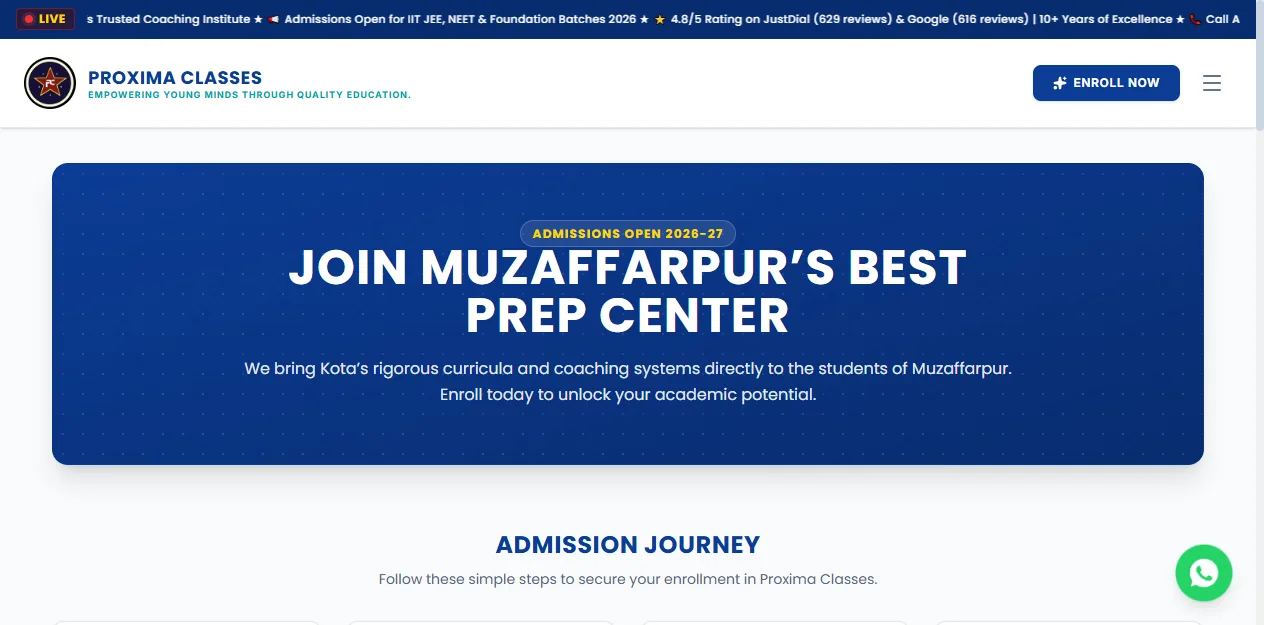 The public admissions side of the same system — the website catches the enquiry, the portal runs everything after it.
The order matters, though. The portal made sense because the admissions engine already worked. If you have forty students and no website, start with the ₹15,000 problem, not the ₹60,000 one. (The full build is written up here: Proxima Classes case study.)
Red flags when you hire someone to build it
The coaching niche attracts template-flippers, because owners are busy and the sale is emotional. Watch for:
- No fixed price. “We’ll see as we go” means the price grows as you’re committed.
- They keep your domain or code. The classic trap. If you can’t take the website elsewhere, you don’t own it — you’re renting it from your developer, forever.
- No timeline in writing. A real quote has real dates.
- They can’t show you a live coaching site they built. Not mock-ups — a real institute, taking real enquiries.
- A “free website” bundled with something else. You’ll pay for it, just not on the invoice.
One more, subtler: they don’t ask about your admissions process. Someone who starts talking templates before asking how a parent currently reaches you is building a brochure, not an admissions tool.
A realistic 10-day plan to get online
What actually happens when this goes well, based on how we run it:
- Days 1–2 — the sit-down. One conversation: your courses, batches, fee posture, results you can prove, photos you have. This is where the site is actually designed.
- Days 3–6 — build. Pages take shape around parent questions. You see progress on WhatsApp, not in a monthly meeting.
- Days 7–8 — content and proof. Results, faculty photos, real classroom shots go in. The enquiry form and WhatsApp are wired to your phone and tested with a real submission.
- Days 9–10 — launch. Domain connected, Google Business Profile linked, analytics on. You get every login, and a fifteen-minute walkthrough of how to read your enquiries.
The only thing that reliably delays this is content — mostly results photos and faculty details. Start collecting those before you hire anyone, whoever you hire.
If you run a coaching institute and want a straight answer on what your situation needs — website, portal, or honestly nothing yet — tell us about your institute. We’ll give you a fixed price and a real timeline, and if a ₹15,000 site is all you need, that’s exactly what we’ll say. You can also see how we work with coaching institutes, or if you’re nearby in Gujarat, we’re based in Bardoli and happy to talk over chai.
Quick questions
Does a small coaching class really need a website, or is Instagram enough?
Instagram builds awareness; the website closes the admission. When a parent hears about you, they search your name on Google. If nothing credible comes up, the trust you built offline leaks away. Most classes need a simple 5–6 page site, not a big portal.
How much does a coaching institute website cost in India?
A proper admissions website — courses, results, faculty, batch timings, WhatsApp enquiry — starts around ₹15,000. A full student portal with online tests, fees and attendance is a different project, starting around ₹60,000. Anyone quoting one price for both isn't scoping honestly.
What pages should a coaching class website have?
Six cover almost everything: Home, Courses & Batches, Results, Faculty, About, and Contact/Admissions. Each page should answer a real parent question, not read like a brochure.
Can the website collect admission enquiries automatically?
Yes — that's its main job. A short form (name, phone, class) plus a WhatsApp button, with every enquiry landing in your inbox and on your phone instantly. If enquiries sit in a dashboard nobody checks, the website is failing.
Should I show my fee structure on the website?
Show at least a starting range. Parents comparing classes filter out institutes that hide everything. You don't need a full rate card — 'batches from ₹X/month' with a 'talk to us' button beats silence.
How do I show results without exaggerating?
Use real names, real ranks, real photos — with permission. Parents in your town know who actually topped. One honest results wall beats fifty stock-photo toppers, and fake claims can sink your reputation locally.
What is an online test portal, and when do I need one?
It lets students take tests online and shows you their weakest topics, instead of just marks. It makes sense once you have a few hundred students and tests every week — before that, a simple website with enquiry capture earns its keep first.
How long does it take to build a coaching website?
About ten days for an admissions website, if your content — courses, photos, results — is ready. Portals take three to five weeks. Be suspicious of both 'tomorrow' and 'three months'.
Who should own the website when it's done?
You. Domain, code, content — everything in your name, with logins handed over. If the developer keeps the domain or the code, you're renting your own website, and you'll feel it the day you want to change anything.
Will a website get me admissions from Google?
Over time, yes — parents search things like 'JEE coaching near me' and your town's name all year. A fast site with your courses, results and location laid out properly can rank for those searches. But treat Google as a bonus in year one; the website's first job is converting the parents who already heard your name.